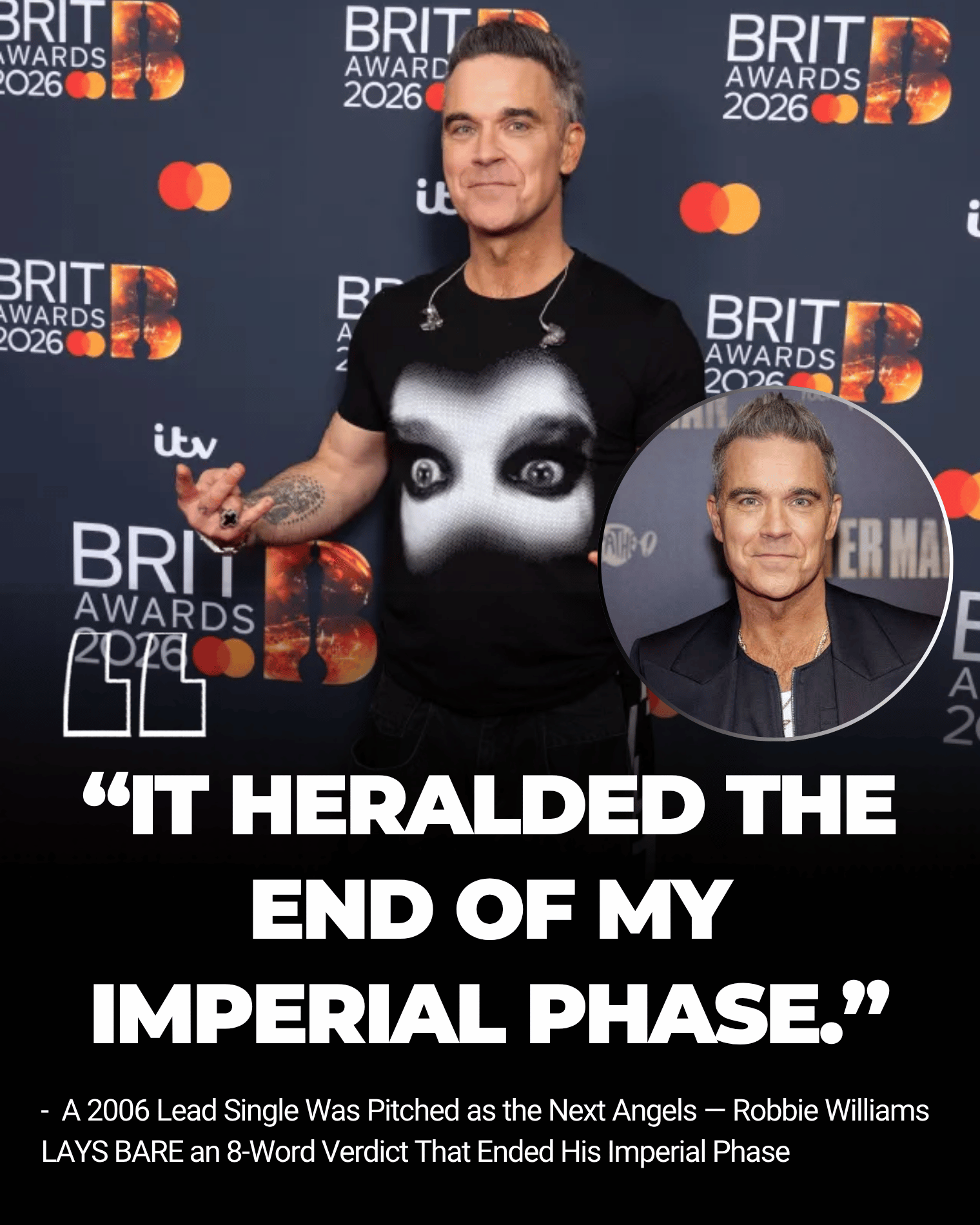
Robbie Williams once stood in front of a crowd convinced he was about to unleash another untouchable anthem, another towering singalong with the emotional electricity of “Angels.”
Instead, the former Take That star now sees that moment as the warning flare before one of pop’s most glittering solo reigns began to flicker.
In Netflix’s Robbie Williams, the singer revisits old footage of himself introducing 2006’s “Rudebox” with the confidence of a man who believed lightning was ready to strike twice.
He pitched the oddball dance-rap track as a potential follow-up to “Angels,” the colossal 1997 ballad that transformed him from boy-band escapee into a stadium-filling British institution.
But hindsight did not merely humble Williams; it hit him like a public verdict from the very era he thought he was about to extend.
“Rudebox heralded the end of my imperial phase,” he admitted, delivering eight words that turned an ambitious release into a brutal marker of collapse.
The confession lands especially hard because “Rudebox” was not some forgotten B-side or rushed contractual release buried quietly between eras.
It was the lead single from an album carrying his name, his swagger, and his still-massive belief that audiences would follow wherever he chose to go.
At the time, Williams had spent years dominating British pop with a level of charisma that felt almost unfair to his competitors.
From “Rock DJ” and “Feel” to “Let Me Entertain You,” he had become a showman who could turn self-doubt into spectacle and spectacle into national obsession.
Then came “Rudebox,” a track that did not sound like the Robbie Williams many listeners thought they knew, and certainly not the comforting, sweeping sequel to “Angels” he had promised.
The song leaned into electro, rap, funk, and deliberate weirdness, sounding less like a coronation anthem than a left turn taken at full speed.
Williams later called releasing it his biggest career regret, a statement that reveals how deeply the song’s reception wounded a performer famous for turning criticism into comedy.
Yet the singer’s reflection is more complicated than simple embarrassment, because he still believes “Rudebox” mattered almost as much as “Angels.”
That is the cruel twist: “Angels” helped launch his imperial phase, while “Rudebox” became the song that exposed its ending.
One was a soaring invitation for millions of fans to see themselves in his vulnerability, while the other became proof that even the biggest personalities can misjudge the room.
For Williams, the single was not simply a commercial detour; it was evidence that the machinery surrounding a superstar can keep moving long after the emotional momentum starts slipping away.
The footage now plays like a time capsule of a man trying to sell triumph while standing unknowingly at the edge of a transition.
There is something strangely powerful in his willingness to revisit that boast instead of pretending the era never happened.
He did not blame fans for rejecting the song, nor did he hide behind labels, producers, or changing radio trends.
He looked directly at the gamble, the confidence, and the misfire, then admitted that the record he expected to continue his domination had actually announced the end of it.
That does not erase the legacy of Robbie Williams’ blockbuster years, but it gives them a sharper, more human ending.
“Rudebox” may not have become the next “Angels,” yet it became something far more revealing: the sound of a pop emperor realizing the crown had started to slip.