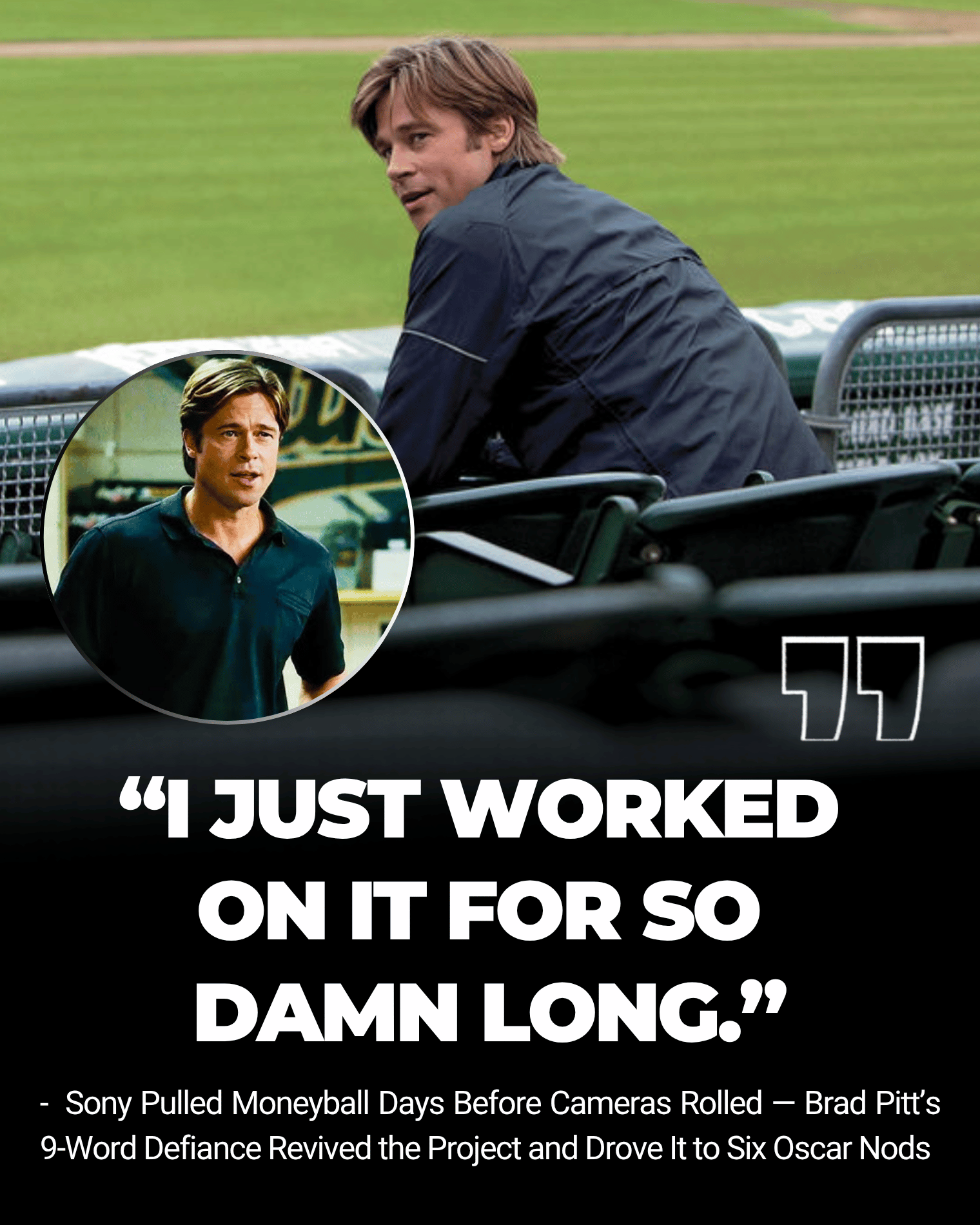
Brad Pitt had already committed himself to the unlikely baseball drama when Sony suddenly pulled the plug, leaving a major production stranded only days before cameras were supposed to roll.
The shock reportedly came after director Steven Soderbergh delivered a bold late rewrite that alarmed the studio, transforming the project’s carefully planned path into an expensive question mark.
Then came the brutal fallout: Pitt, who was not only the star but also a producer, found himself facing a shutdown that left roughly 230 crew members without work.
For a movie about outsiders refusing to accept the usual rules, Moneyball had suddenly become its own underdog story, abandoned before it could even step onto the field.
Warner Bros. passed. Paramount passed. The industry had looked at Michael Lewis’s dense story about baseball economics, Oakland Athletics general manager Billy Beane, and statistical rebellion, then decided it was too risky.
But Pitt was not ready to walk away from the project he had spent years trying to bring to life. “I just worked on it for so damn long,” he later said.
Those nine words carried the frustration of someone who had watched the film collapse at the last possible moment, only to refuse the easy Hollywood exit.
Pitt did not treat the cancellation as the end of Moneyball; he treated it like another inning, one where the scoreboard looked ugly but the game was not over.
The rescue took time, patience, and a new creative team willing to find the movie’s emotional heartbeat without losing the intellectual nerve that made the story unusual.
Bennett Miller eventually stepped in to direct, while Aaron Sorkin joined Steven Zaillian in shaping a script that made spreadsheets, scouting reports, and salary limits feel unexpectedly cinematic.
The final film did not become a traditional sports fantasy about a championship trophy or a last-second triumph under stadium lights. Instead, it focused on failure, pressure, loyalty, and the lonely cost of challenging a system.
Pitt’s Billy Beane was not presented as a flawless genius, but as a man trying to force an entire sport to recognize value where powerful people refused to look.
When Moneyball finally arrived in theaters in 2011, the project that had once been treated like a financial disaster became one of the year’s most admired films.
It earned six Academy Award nominations, including Best Picture, Best Actor for Pitt, Best Supporting Actor for Jonah Hill, Best Adapted Screenplay, Best Sound Mixing, and Best Film Editing.
The twist was almost too perfect: a studio shutdown meant to stop the movie permanently became part of the legend that made its eventual success feel even bigger.
Pitt had spent five years protecting a story about believing in overlooked potential, and in the end, Moneyball proved its own message with every nomination it collected.